
Tax Credits and Incentives for Historic Restorations
Tax credits and incentives can offset restoration costs and improve project feasibility
Historic rehabilitation projects often face higher upfront costs and complex regulatory requirements. Tax credits and incentives for historic restorations are powerful tools that reduce those financial burdens and make preservation projects feasible. helps owners identify which programs apply to their property and prepares compliant submissions so projects move forward with confidence.
Whether you are an owner-developer, non-profit steward, or private homeowner, understanding the landscape of available incentives is critical. Many programs reward projects that maintain historic character while improving energy performance and accessibility. Our team translates guidelines into actionable steps, helping owners harness incentives to close funding gaps and protect cultural value.
Call for assistance navigating incentives and securing maximum benefit. Early involvement yields the best outcomes: identifying potential credits before construction planning allows design choices that preserve eligibility and optimize financial impact. provides strategic counsel from feasibility through final certification to ensure incentives are claimed appropriately and documented thoroughly.
Overview of common tax credits and incentives for historic restorations
A range of federal, state, and local programs exist to encourage rehabilitation of historic buildings. The most widely used federal program, the Historic Rehabilitation Tax Credit, provides a percentage of qualified rehabilitation expenditures back to the project owner as a credit against taxes owed. State and local jurisdictions often layer additional credits, grants, or tax abatements to improve return on investment.
Beyond direct tax credits, incentives can include low-interest loans, property tax freezes, faade grant programs, and energy-related incentives that reward historic properties that also upgrade efficiency. Combining multiple programs often yields the best financial outcome, though stacking rules and timing considerations can restrict which incentives can be used simultaneously.
- Federal Historic Tax Credit - Usually a substantial percentage credit for certified rehabilitation on income-producing properties.
- State and local historic tax credits - Vary by jurisdiction; often refundable or transferable in some states.
- Rehabilitation grants and faade programs - Targeted funding to offset specific conservation tasks.
- Energy efficiency incentives - Rebates or credits for upgrading HVAC, insulation, windows, or installing renewable systems sensitively.
- Property tax incentives - Abatements or freezes that stabilize carrying costs during rehabilitation.
Eligibility and regulatory compliance: what owners must know
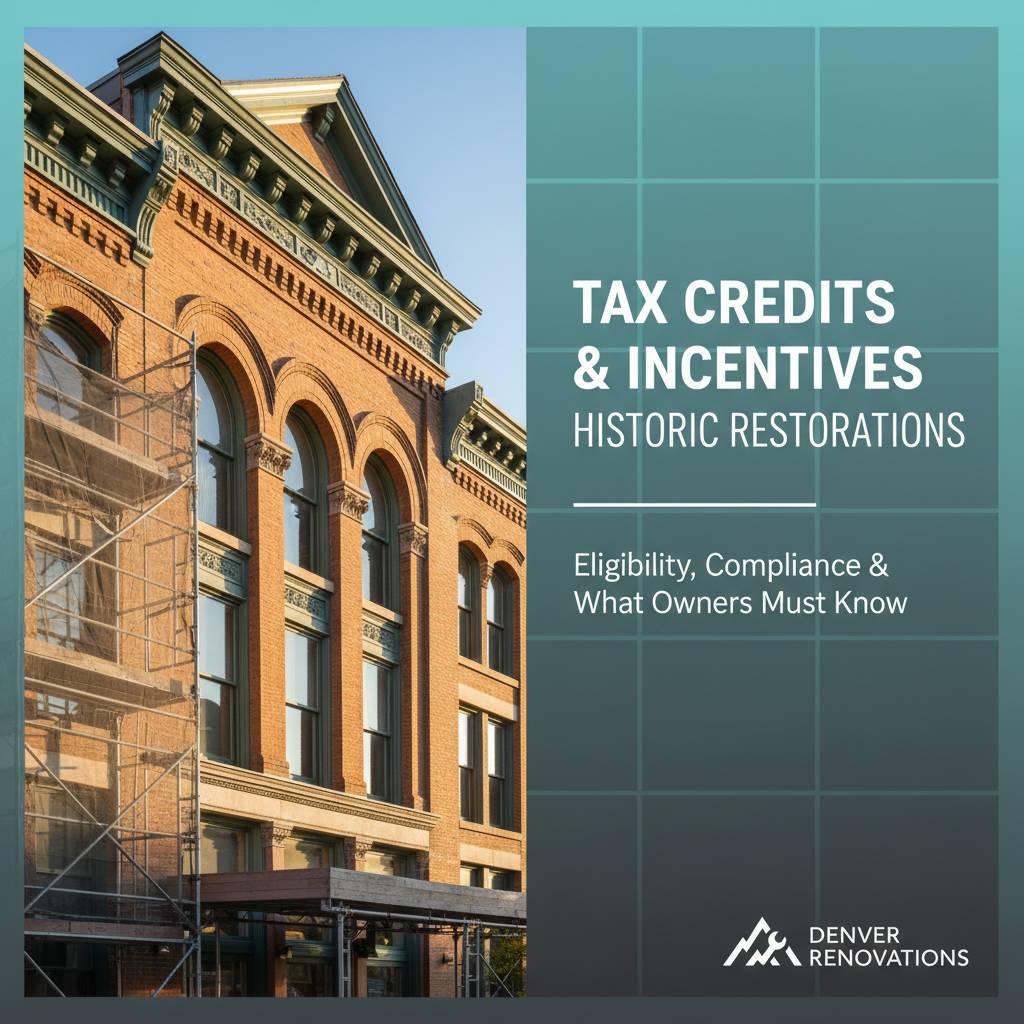 Eligibility for tax credits and incentives typically hinges on the building's designation and the quality of rehabilitation work. Many programs require that properties be listed on or eligible for the National Register of Historic Places, or recognized by a state or local landmark register. Certification processes are intended to protect historic character by ensuring that exterior and, where applicable, interior changes are consistent with established preservation standards.
Compliance usually involves documented evidence at multiple stages: pre-approval concept reviews, detailed work plans, progress photographs, financial accounting of qualified rehabilitation expenditures, and final certification inspections. Meeting the Secretary of the Interior's Standards for Rehabilitation is a common requirement-work that departs from these standards risks denial of credits, so early coordination with preservation authorities is essential.
Timing and ownership structure also matter. Tax credit eligibility can depend on the date of acquisition, the property's tax status, and whether the owner is an individual, partnership, or corporation. Transferability or sale of a property during the rehabilitation period can complicate claims. can help clarify these nuances so owners structure transactions and schedules to preserve benefits.
Identifying applicable programs: practical steps and comparison
Effective identification of applicable incentives starts with a structured assessment of the property and project scope. Begin by confirming historic status, then map potential incentives by jurisdiction and by project components-faade work, mechanical upgrades, accessibility improvements, and renewable energy installations each attract different incentives. A coordinated inventory reduces the risk of missing opportunities and prevents incompatible program combinations.
Below is a simple comparison to help owners evaluate common program types by typical benefit and common requirements. Use this as an initial guide; local program specifics vary and should be verified with qualified counsel.
| Program Type | Typical Benefit | Common Requirements |
|---|---|---|
| Federal Historic Tax Credit | Large percentage credit on qualified expenses | Certified historic, qualified rehabilitation expenditures, Secretary of the Interior Standards |
| State Historic Tax Credits | Additional percent credit or refundable cash | State-specific designation and application process |
| Faade & Preservation Grants | Direct funding for specific elements | Competitive application, local matching funds may be required |
| Energy Incentives | Rebates, tax deductions, or credits for upgrades | Performance verification, specification compliance |
After mapping potential incentives, apply a program compatibility check: confirm stacking rules, deadline alignment, and documentation overlap. This reduces administrative risk and maximizes the combined financial effect of multiple incentives.
Preparing a strong submission and avoiding common pitfalls
 Successful claims depend on meticulous documentation and clear alignment between proposed work and program requirements. A strong submission typically includes a narrative that ties rehabilitation activities to preservation standards, detailed budgets that distinguish qualified rehabilitation expenditures from non-qualifying costs, annotated photographs, architectural drawings, and a compliance timeline. Submissions that lack specificity or fail to tie interventions to standards are frequently delayed or denied.
Common pitfalls include misclassifying costs, commencing construction before receiving required approvals, and failing to maintain adequate photographic records. Contractors unfamiliar with historic preservation methods can inadvertently alter character-defining features, jeopardizing credit eligibility. Owners should establish documentation protocols and incorporate preservation-minded specifications into construction contracts to protect eligibility.
- Obtain pre-approval when required; never assume retroactive approvals will be granted.
- Keep separate accounting for qualified rehabilitation expenditures versus general maintenance.
- Document conditions before work, during progress, and after completion with high-resolution images and dated logs.
- Engage preservation consultants early to vet materials and methods against applicable standards.
assists with preparing narratives, cost schedules, and photographic documentation that align with reviewer expectations. Our approach focuses on reducing review cycles and mitigating risk so investments deliver predictable tax benefits.
Financial modeling and how incentives change project feasibility
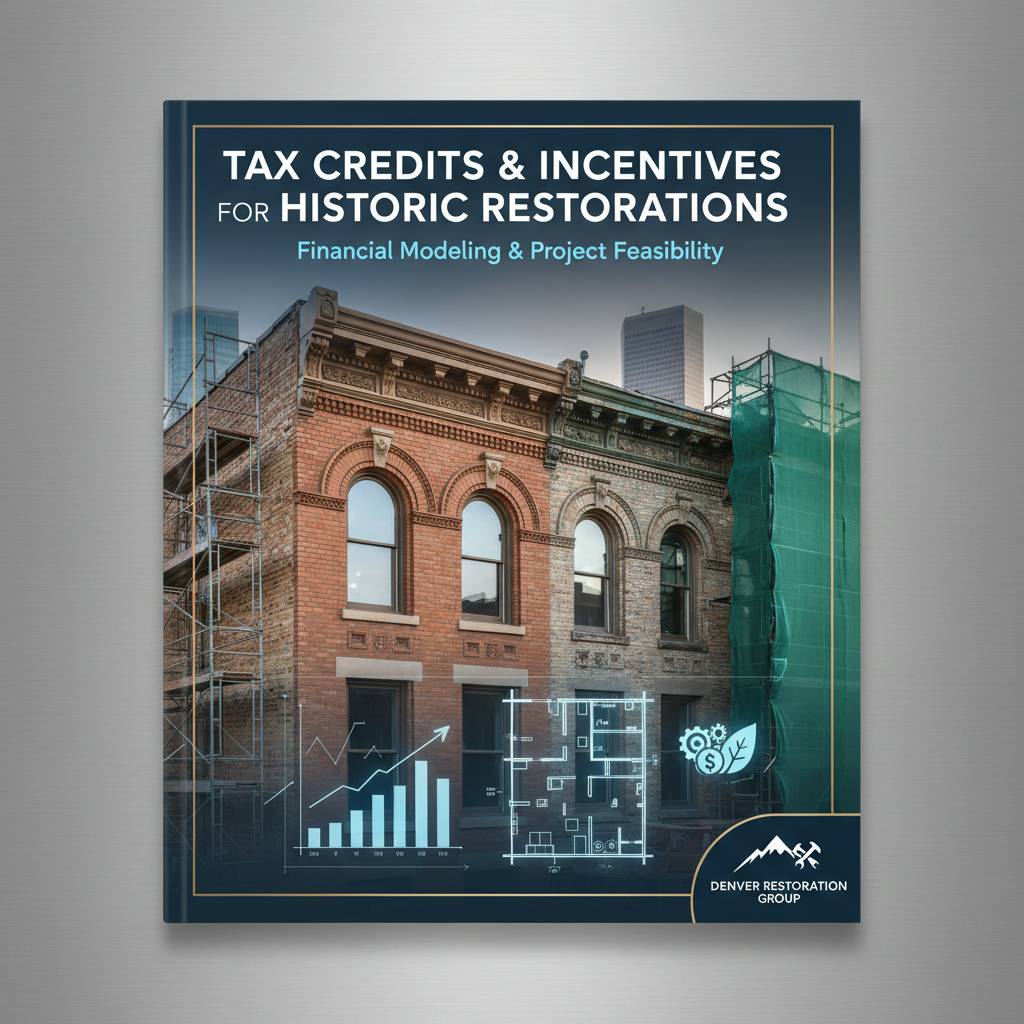 Incentives can materially change whether a restoration project is financially viable. Incorporating credits and grants into pro forma analyses often transforms marginal projects into bankable ones by lowering net capital requirements and improving cash-on-cash returns. For example, a federal credit combined with a state credit can reduce net rehabilitation costs by a significant percentage, shortening payback periods and enhancing project-level internal rates of return.
Accurate financial modeling requires realistic cost estimates and conservative assumptions about credit timing and receipt. Restoration costs vary widely by building condition and scope; for many projects, contractors estimate selective restoration and systems upgrades in the range of $75-$200 per square foot depending on complexity. Credits reduce the effective cost basis and improve project debt service coverage, but lenders typically require documented approvals or escrow arrangements to account for credit timing.
We build models that stress-test scenarios-delays in certification, partial denials, varying stacking outcomes-and produce contingency strategies that preserve feasibility. Modeling also helps owners evaluate whether to monetize credits through transfer programs, syndication, or to retain credits on their tax rolls, and whether alternative financing tools like tax-exempt bonds or preservation loans are appropriate.
Case studies and illustrative examples
 Real-world examples clarify how incentives function and where advisory support adds value. Consider a mixed-use downtown building where certified rehabilitation costs of $2,000,000 qualified for a federal credit and a state credit. Together, these credits offset a substantial portion of the rehabilitation budget, enabling updated retail spaces, modernized apartments, and faade restoration without compromising historic fabric. Proper sequencing of approvals allowed credits to be claimed without construction delays.
In another example, an owner of a landmark residence used a combination of energy rebates and local faade grants to complete essential envelope repairs and install high-efficiency mechanical systems that preserved historic windows. Although the federal credit was not available for an owner-occupied residence, the layered incentives reduced out-of-pocket costs and improved long-term energy performance.
- Example 1: Income-producing property - Combined credits reduced net cost and attracted private lending.
- Example 2: Owner-occupied landmark - Local grants and energy incentives funded targeted preservation work.
- Example 3: Adaptive reuse - State credits plus historic tax credits made conversion from industrial to residential economically viable.
How helps owners navigate incentives and reduce financial barriers
 provides end-to-end advisory services designed to maximize incentive capture and minimize administrative risk. We evaluate properties, identify applicable programs across federal, state, and local levels, prepare submission packages that meet reviewer expectations, and work with preservation agencies to resolve questions during review. Our goal is to streamline approval, reduce review cycles, and turn potential tax benefits into realized value.
Our services include eligibility assessments, cost allocation guidance, submission preparation, and coordination with legal and tax advisers. We also support financial modeling and lender communications so incentive timing is reflected in project financing. By handling technical submissions and compliance matters, frees owners to focus on design quality and construction while maintaining eligibility for incentives.
Call for a no-obligation discussion about how tax credits and incentives for historic restorations could materially improve your project's prospects. We will review your property's historic status, outline likely incentives, and propose a practical next-step plan to preserve eligibility while optimizing project economics.
Next steps and brief call to action
If you are considering a restoration project, begin with a targeted eligibility review to identify immediate opportunities and constraints. Early planning avoids irreversible choices that can disqualify credits and ensures design decisions support both preservation and financial goals. can perform that review and outline an incentive strategy aligned with your timeline and budget.
To schedule an assessment or learn more about program specifics in your jurisdiction, contact at . Our team responds promptly and will help you weigh options, prepare documentation, and keep your restoration compliant and funded.
Preserving historic buildings delivers cultural and economic returns. With the right incentives and expert guidance, restoration becomes not just possible but prudent. Reach out to at to get started today.